

GOC Standard 1: Listening to Patients in Optical Practice
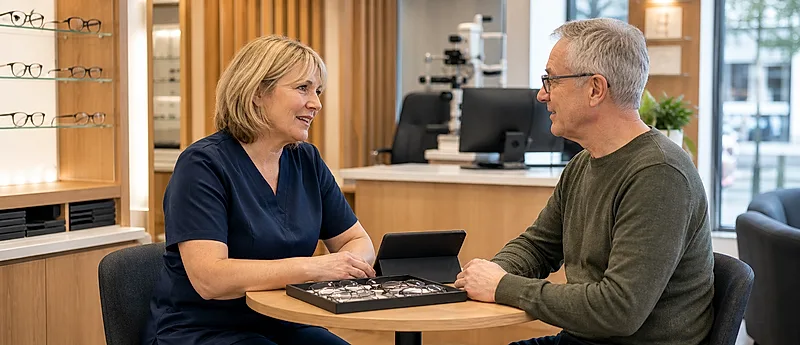
Strengthening Patient Partnerships Through Communication
Welcome to this practical course designed to help optical professionals meet the General Optical Council (GOC) Standard 1 by putting effective listening and patient‑centred communication at the heart of everyday practice. Good listening is not optional - it's a clinical skill that reduces diagnostic error, supports shared decision‑making, improves adherence, strengthens safeguarding and continuity of care, and demonstrably fulfils your professional duties.
What you will learn
- Why listening is clinical practice: Understand how attentive history‑taking and patient engagement identify subtle symptoms and red flags (e.g., transient diplopia, flashes), and how this links to safety and outcomes.
- Core patient‑centred decision‑making: Learn to combine clinical expertise, best evidence and the patient's lived experience to reach shared decisions that are documented and defensible.
- Active listening skills: Practical techniques - open questions, reflection and clarification, non‑verbal attending, strategic silence, and preventing premature closure.
- Communication adaptations: How to tailor interactions for culture, language, sensory needs, neurodiversity, cognitive impairment and limited health literacy; when and how to use professional interpreters and accessible materials.
- Documentation that demonstrates compliance: What to record - patient's words, concerns, options discussed, risks, preferences, rationale and safety‑netting - to show adherence to Standard 1.
- Handling common clinical scenarios: Concise action steps for rushed consultations, language/cultural barriers, cognitive or behavioural challenges, and complex family dynamics.
- Practical exam and workplace tips: How to cite Standard 1 in assessments, prioritise safety, and use examples that show both urgent action and longer‑term adaptations.
This course equips you with the specific behaviours and documentation practices that evidence compliance with GOC Standard 1 - open questioning, reflection, teach‑back, interpreter use and recording the patient's voice.
How this course will help you
- Improve diagnostic accuracy and patient safety by eliciting full accounts and identifying red flags early.
- Strengthen shared decision‑making so care aligns with what matters to each patient (comfort, function, appearance, cost).
- Reduce complaints and improve adherence by checking understanding (teach‑back) and documenting the consultation process.
- Enable inclusive care by offering practical adjustments for sensory needs, language access, neurodiversity and cognitive impairment.
- Provide clear, defensible records that link subjective concerns with objective findings and the agreed plan.
Practical skills and actions you can apply immediately
- Start with open questions, then use focused closed questions to clarify onset, frequency, laterality and triggers.
- Reflect and summarise: "So the discomfort starts after about two hours of near work?"
- Use non‑verbal attending - face the patient, open posture, appropriate eye contact - and position instruments/screens to maintain visibility.
- Build structure into pressured consultations: signpost, prioritise concerns, offer follow‑up and safety‑net advice.
- Use teach‑back and accessible materials (large print, diagrams, translated text) and document the adaptations used.
- When red flags appear, act promptly: perform urgent examination or arrange same‑day ophthalmology referral and document patient wording and the rationale.
Quick checklist to show compliance with GOC Standard 1
Before completing the record, ensure you have:
- Noted the patient's main concern in their words.
- Linked subjective concerns with objective findings (e.g., symptom ↔ VA / slit lamp / fields).
- Documented options discussed, risks, patient preference and the agreed plan with rationale.
- Recorded any adaptations used (interpreter, extended appointment, teach‑back).
- Added safety‑net advice and clear follow‑up arrangements where relevant.
Course structure and scenarios
You will work through concise scenario summaries with action steps for:
- Rushed consultations where important symptoms are disclosed late.
- Consultations with language or cultural barriers and safe interpreter use.
- Encounters with cognitive impairment, autism spectrum presentations or sensory sensitivities.
- Family dynamics where a relative may dominate communication.
Each scenario highlights immediate safety actions, communication adjustments and how to document the process.
Final note
Listening is an active clinical intervention. By the end of this course you will be able to demonstrate through both behaviour and records that your consultations are patient‑centred, safe and compliant with GOC Standard 1. We are pleased you are taking this step to strengthen patient partnerships and improve outcomes in optical practice.
Sign up now for a free account
Course tools & details

