

Recording optical measurements within role
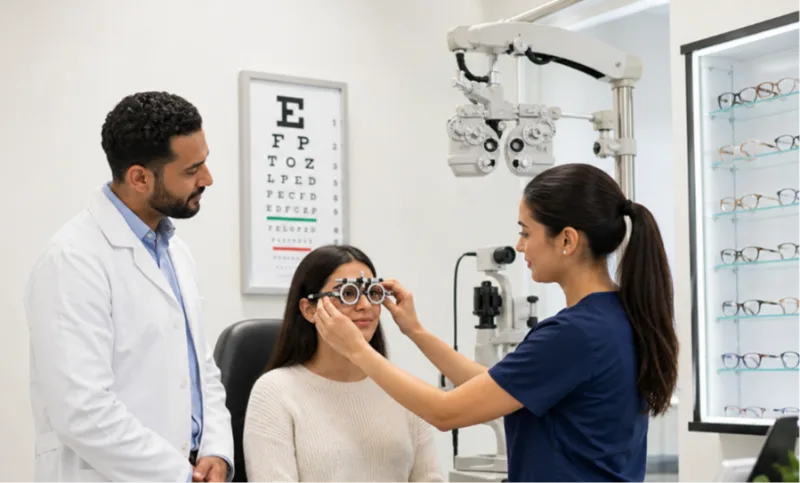
Optical assistants may take or record measurements for dispensing support, collections, repairs, pre-screening or order preparation. Only record measurements you are trained, authorised and supervised to take.
A measurement is useful only when another person can interpret it. Numbers without labels, units, frame details or any note of uncertainty can cause errors later.
Record measurements clearly
- Use correct labels: mark right and left, monocular or binocular, and distance or near where relevant.
- Use correct units: record millimetres, dioptres, prism direction or other units exactly as local procedure requires.
- Include context: note the task, chosen frame, lens type, patient position or device method where relevant.
- Identify the author: make clear who took or entered the measurement.
- Show uncertainty: record difficulties such as repeated attempts, movement, poor fixation or patient discomfort.
- Hand over limits: pass anything outside your training to a dispensing optician, optometrist or authorised colleague.
PD and dispensing measurements
Pupillary distance is a clear example. PD is a dispensing measurement used to help make spectacles, not a clinical interpretation for support staff to provide. If your role includes taking PD, follow the local method and record whether it is monocular or binocular and what it relates to.
Fitting heights, frame dimensions and lens options need context. A measurement taken for one frame or fitting position may not be safe for another. If the patient changes frame, posture or lens choice, check local procedure to see whether a new measurement is required.
Good measurement records show the number, the context, the author and any uncertainty.
Ask Dr. Aiden
Rate this page
Sign up now for a free account
Course tools & details

