

Welcome to GOC Standard 8: Maintaining Adequate Patient Records in Optical Practice
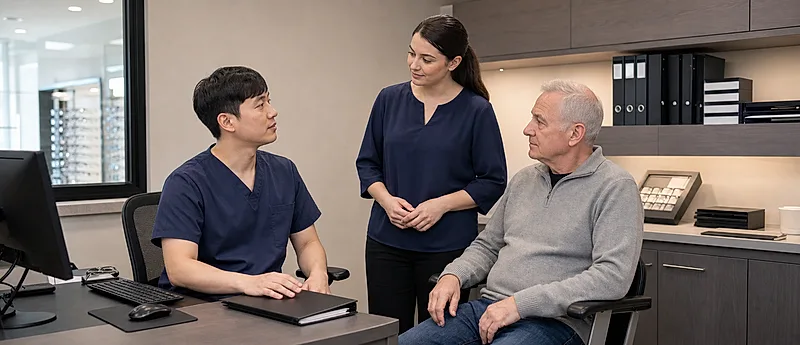
Welcome and thank you for joining this focused CPD course on patient record‑keeping in optical practice. Good records are a cornerstone of safe, effective care - they protect patients, support colleagues, and provide robust evidence of clinical reasoning and consent. This course will help you translate GOC Standard 8 and relevant UK law into practical, everyday documentation habits that improve patient safety and reduce professional risk.
Why this course matters
Accurate, legible and contemporaneous records:
- Ensure clinical continuity so another competent practitioner can understand the patient story and act appropriately.
- Demonstrate that patients were informed and consented to care.
- Support audit, learning and service improvement.
- Provide primary evidence if care is challenged in complaints or litigation.
This course covers not just what to record, but how to record it correctly - including imaging provenance, corrections and late entries, SARs, data protection obligations and retention.
Keep it simple: use SOAP (Subjective, Objective, Assessment, Plan) every consultation and the I.D.E.A.L. memory aid (Identity, Date/time, Evidence, Assessment, Logistics) for every record.
What you will learn
- The core requirements of GOC Standard 8 and relevant UK frameworks (NHS Records Management Code of Practice, UK GDPR/Data Protection Act 2018).
- A practical SOAP‑based minimum content checklist to use for every encounter.
- How to document imaging and perimetry with full provenance (patient identifiers, device, operator, date/time, quality metrics).
- Correct procedures for corrections, addenda and late entries - never overwrite originals.
- Stepwise handling of Subject Access Requests (SARs) and timelines (one month standard).
- Retention schedules, secure disposal and how to manage legal holds.
- EHR and device workflow best practice: templates, role‑based access, scan‑and‑link and downtime procedures.
- How to audit records, set measurable standards and close the improvement loop.
Course highlights / modules
- Introduction: Legal and regulatory expectations
- SOAP in practice: sample entries and wording you can reuse
- Imaging and device outputs: metadata, linking and misfiled image workflows
- Corrections, late entries and addenda: good practice and examples
- Data sharing, consent and SARs: lawful bases, secure channels and redaction
- Retention, destruction and legal holds: schedules and certificates
- EHRs and hybrid workflows: configuration, templates and downtime plans
- Audit and improvement: measurable standards, sampling and re‑audit
- Scenario modules: paediatric patients, severe visual impairment, mislabelled OCT, missing legacy notes
Practical skills you will gain
- Use a SOAP template to speed documentation while retaining clinical reasoning.
- Record device details and image provenance so attachments are admissible and trustable.
- Create dated, signed addenda and log corrections without deleting originals.
- Verify and respond to SARs in compliance with deadlines and format expectations.
- Run simple audits (e.g., laterality, safety‑netting, imaging metadata) and implement change cycles.
Who should complete this course
- Optometrists and prescribing optometrists
- Dispensing opticians and practice clinical staff
- Practice managers, information governance leads and IT staff in optical practices
- Clinicians preparing for appraisal, revalidation or regulatory inspection
How to get the most from the course
- Use the downloadable pass notes and SOAP checklist to rehearse entries.
- Practice writing short, structured entries using the example language provided.
- Review your EHR templates and device export settings against the imaging metadata checklist.
- Run a small audit in your practice (sample 20 - 30 records) to test compliance with one or two standards and act on findings.
- Keep a short personal log of record‑keeping queries to discuss with colleagues or governance leads.
Outcomes and benefits
By the end of this course you will be able to:
- Produce records that meet GOC Standard 8 and UK legal requirements.
- Improve clinical safety and continuity through structured documentation.
- Reduce risk by handling corrections, SARs and imaging provenance correctly.
- Demonstrate improvement through audit and integrate better record‑keeping into everyday practice.
We are pleased to have you on board. Use the practical tools and examples here to make immediate, measurable improvements to your record‑keeping - your patients, colleagues and your professional defence will benefit.
Sign up now for a free account
Course tools & details

