

Understanding risk before clinical assessment
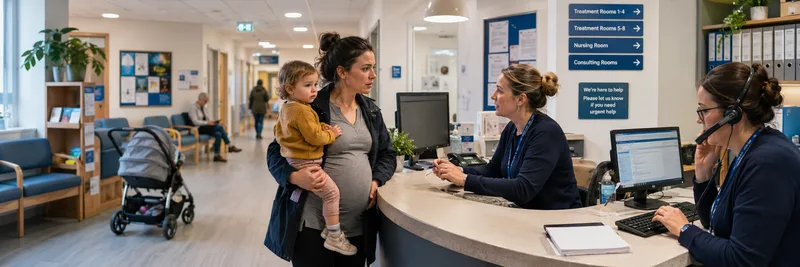
Before a clinician assesses the patient, safety depends on recognising contacts that are not suitable for routine handling. Babies, children, pregnant people and recently pregnant people may need urgent clinical ownership even when the caller is uncertain.
Reception staff do not need to make a diagnosis. A baby who is not feeding, a child with a worrying rash, or a pregnant patient with reduced fetal movements requires the correct escalation route rather than a receptionist’s clinical judgement.
What makes these contacts higher risk
- The patient may not be able to explain the problem: babies and young children rely on adults to notice changes.
- Symptoms can change quickly: poor feeding, reduced consciousness, breathing difficulty or dehydration may deteriorate while waiting.
- Pregnancy changes the threshold: reduced fetal movements, bleeding, severe headache or collapse should not remain in routine queues.
- Recent pregnancy still matters: serious infection, heavy bleeding, chest pain, breathlessness or a mental health crisis can occur after birth, miscarriage or termination.
- Parental concern is useful information: phrases such as "I know my child and this is not right" indicate a need for prompt attention.
Keep the question practical
The practical question is not "What is the diagnosis?" but "Is this safe to handle as routine?" If the answer is no, or if there is real uncertainty, follow the local escalation route.
Useful first-contact details to capture are the exact words used, the patient’s age or pregnancy/recent pregnancy status, the patient’s current location, a safe call-back number, whether symptoms are occurring now, and whether emergency help has already been sought.
First-contact safety is about recognising when routine handling is unsafe, not about making a clinical diagnosis.
Ask Dr. Aiden
Rate this page
Sign up now for a free account
Course tools & details

