

Welcome to GOC Standard 7: Conducting Appropriate Assessments and Referrals in Optical Practice
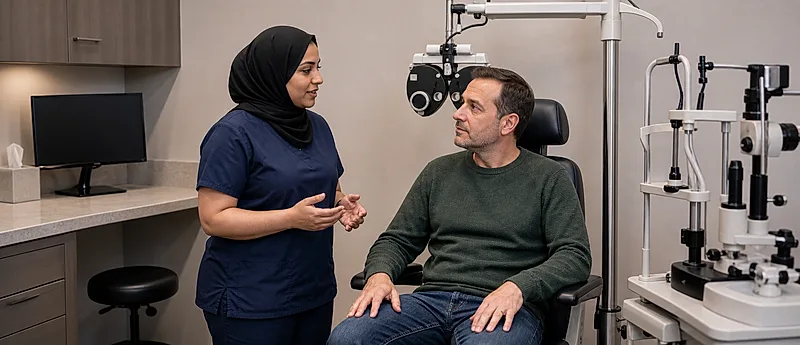
Welcome - this course is designed for optical professionals who need to demonstrate safe, effective and timely clinical decision-making in line with the General Optical Council's Standard 7. You will learn how to perform proportionate assessments, recognise red flags, adapt care for diverse patients, produce high-quality referrals, and document your reasoning so another clinician can reconstruct what was done and why.
What you will learn
- The core meaning of Standard 7: carry out assessments, examinations, treatments and referrals that are appropriate, proportionate and timely.
- How to use a structured history to form the clinical question and direct testing - remember: history often yields the highest diagnostic value.
- A practical decision framework: Assess → Test (proportionately) → Manage / Monitor / Escalate.
- How to recognise and act on red flags that require same‑day or emergency pathways.
- What makes an effective referral: clear clinical question, working diagnosis, urgency, key positives and relevant negatives, and attachments (images/tests).
- Documentation principles so your notes are contemporaneous, reconstructable and defensible.
- Practical adaptations for patients with communication, sensory, developmental or cognitive differences.
- Reflection, audit and CPD strategies to evidence ongoing competence in line with GOC expectations.
Standard 7 in one line: do the right assessment for the right patient at the right time - not maximal testing, but testing that will change management.
How this course will help you
- Improve patient safety by strengthening red‑flag recognition and escalation decisions.
- Reduce unnecessary testing and referral delays through question‑driven assessment.
- Increase referral acceptance and speed by providing concise, evidence‑based referrals with attachments.
- Strengthen record keeping so colleagues and secondary care can confidently continue care.
- Provide CPD evidence: structured reflections, audit templates and examples to map to GOC Standards 5, 6 and 7.
Course content and structure
- Introduction and key principles of proportionate assessment and referral.
- History taking: minimum checklist and how to prioritise questions (onset, laterality, associated symptoms, risk modifiers - OLAR).
- Examination: targeted tests, documentation of reliability and necessary adaptations.
- Red flags: clear trigger list and immediate actions.
- Decision framework: when to test, when to monitor, when to escalate.
- Referral best practice: template, essential items, and wording examples.
- Documentation essentials: what to record every time and how to make notes reconstructable.
- Adapting care: communication techniques, approaches for children, neurodivergent patients and those with severe vision impairment.
- Practical scenarios, common pitfalls and corrective actions.
- Reflection, audit and CPD: tools and examples to evidence Standard 7 compliance.
Practical resources included
- Quick‑reference history and examination checklists.
- Red‑flag trigger list and escalation flowchart.
- Structured referral template (clinical question / working diagnosis / urgency / key findings / attachments).
- Sample safety‑net scripts you can adapt and record in notes.
- Memory aids and mnemonics (e.g. OLAR, QDUKA, SUDDEN).
- Example reflective templates and micro‑audit ideas to support CPD.
Who should take this course
- Optometrists and dispensing opticians seeking CPD aligned to GOC Standard 7.
- Clinicians who refer into secondary eye care or accept referrals from primary care.
- Optical practice leads responsible for governance, referral pathways and record‑keeping.
- Trainees preparing for workplace assessments or revalidation.
Assessment and evidence for CPD
- Complete the course modules and activities, then record structured reflections mapping learning to practice (case → decisions → learning points → action plan).
- Use the provided audit templates to measure referral completeness, red‑flag recognition and documentation quality.
- Keep copies of your referral templates and reflection outputs in your CPD portfolio as evidence of meeting Standard 7.
Tips to get the most from this course
- Always start with a clear clinical question - let it drive which tests you choose.
- Use teach‑back and document patient understanding; record verbatim where possible.
- Attach objective data (OCT, fundus photos, visual fields, B‑scan) to referrals to speed triage.
- When in doubt about capacity or refusal, document the discussion, capacity assessment and exact wording of advice given.
- Rehearse safety‑net phrases and record the time and patient acknowledgement.
- Regularly audit real referrals and share anonymised learning at team meetings.
Quick reference: high‑yield takeaways
- Proportionality over maximalism - the right test at the right time.
- History first - it narrows the differential and targets testing.
- Red flags change the pathway - act immediately for sudden loss, flashes/floaters + curtain, severe eye pain with photophobia, suspected acute angle closure, new diplopia with neurology, signs of giant cell arteritis, or papilloedema.
- A good referral = Clinical question + Working diagnosis + Urgency + Key findings (positives and relevant negatives) + Attachments.
- Good records let someone else reconstruct what was done, why, and what the patient understood.
We are pleased you're joining us. Engage with the checklists, try the referral templates in practice, and use the reflective tools provided - you'll return to this course content frequently as you embed these skills into everyday clinical care.
Sign up now for a free account
Course tools & details

