
When to Escalate a Patient Contact to a Clinician

Safe escalation boundaries for reception, care navigation and frontline admin contacts in general practice

  • Reputation

    No token earned yet.

    Reach 50 points to earn the Peridot (Trainee Level).

  • CPD Certificates

    Certificates

    You have CPD Certificates for 0 courses.

  • Exam Cup

    No cup earned yet.

    Average at least 80% in exams to earn the Bronze Cup.

Launch offer: Certificates are currently free when you create a free account and log in. Log in for free access

Using clinician, 111, 999 and local pathways
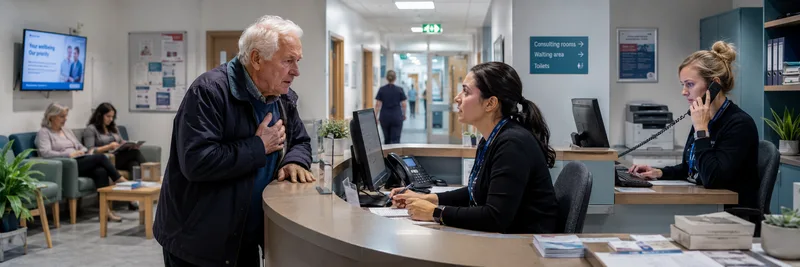
GP practice reception desk with staff and patient

Escalation should transfer responsibility to the person or service that will manage the patient. That may be a duty clinician, 999, NHS 111, a maternity triage pathway, a mental health crisis service, safeguarding advice or another locally agreed route.

The receptionist’s role is to activate the correct route and provide the information required for that service to take responsibility.

Common escalation routes

  • Duty clinician: urgent clinical ownership within the practice when appropriate.
  • 999: suspected life-threatening emergency, using approved local wording.
  • NHS 111 or local urgent care: urgent problems needing advice or triage outside routine practice appointments.
  • Specialist local pathways: maternity triage, mental health crisis teams, safeguarding, palliative care or community services.
  • Senior support: use when a patient refuses advice, there is conflict, uncertainty, failed contact or the usual escalation route is blocked.

Check that ownership has changed

Escalation is more than sending a message. The contact must have a clear owner, and staff must know the local fallback if the first route does not respond.

If a patient refuses the advised route, becomes unreachable, or disconnects after urgent wording, follow the local failed-contact or refusal procedure and document the steps taken.

Scenario

A caller says the patient has become confused and weak overnight.

How should the contact move to the right route?

When to contact 111 for urgent help - BSL - North East Ambulance Service

Video: 3m 4s · Creator: NEAmbulance. YouTube Standard Licence.

This North East Ambulance Service video explains when NHS 111 is appropriate for urgent help and when people should use 999 for life-threatening emergencies. It describes how 111 can direct callers to A&E, an urgent care centre, a local GP, a pharmacist, a dentist, an ambulance response, medicines advice or self-care options.

The video explains that trained health advisers ask questions to judge how quickly help is needed and whether an ambulance or another service is required.

It also covers accessible routes: people who are deaf, hard of hearing or speech impaired can use text or a British Sign Language relay service to contact 111, and callers can request an interpreter. Urgent signposting must include a communication route the person can use.

Was this video a good fit for this page?

Escalation is only complete when the contact has a clear owner or the failed-contact process has been followed.


Ask Dr. Aiden


Rate this page


Course tools & details Study tools, course details, quality and recommendations
Funding & COI Media Credits
