
Chest Pain, Breathing Problems and Collapse: Reception Awareness

Frontline awareness for recognising emergency symptoms and escalating without delay

  • Reputation

    No token earned yet.

    Reach 50 points to earn the Peridot (Trainee Level).

  • CPD Certificates

    Certificates

    You have CPD Certificates for 0 courses.

  • Exam Cup

    No cup earned yet.

    Average at least 80% in exams to earn the Bronze Cup.

Launch offer: Certificates are currently free when you create a free account and log in. Log in for free access

Urgent routes: clinician, 111, 999 and local pathways
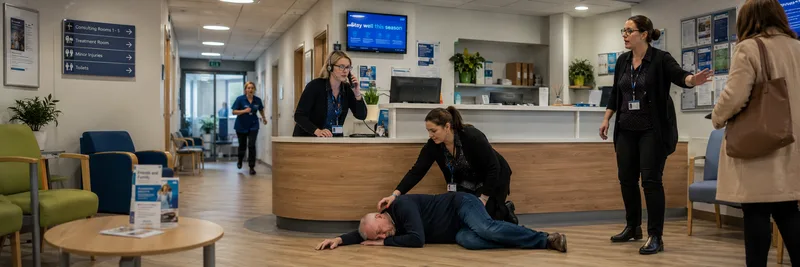
GP reception area with staff assisting collapsed patient

Urgent contacts must reach a person or service who will take clinical responsibility. Depending on wording, setting and local protocol this may be the duty clinician, 999, NHS 111, a maternity or mental health crisis pathway, safeguarding support, or another agreed urgent service.

The receptionist's role is to start that route, not to hold the risk while deciding on clinical care. When symptoms sound life-threatening, local wording should set out how staff advise emergency help and how they record what was said.

Common escalation routes

  • Duty clinician: for urgent clinical ownership within the practice when local protocol specifies this route.
  • 999: for suspected life-threatening emergencies, using approved practice wording and local arrangements.
  • NHS 111 or local urgent care: for urgent problems that are not being managed as immediate emergencies.
  • Specialist local pathways: for maternity, mental health crisis, palliative care, safeguarding or care-home escalation where these exist.
  • Manager or senior support: when there is refusal, conflict, uncertainty, failed contact or an unclear route.

Do not let the route stall

Escalation must result in someone accepting ownership. A message left unseen in a task list, an online request sitting in a queue, or a note added without checking who will act may not be sufficient for urgent contacts.

If a caller refuses 999 because they want a GP to attend first, follow local process. Do not reassure them personally that waiting is safe. Record the refusal, the exact wording used, the advice or escalation given, and who was informed.

Scenario

A parent says their child is breathing fast and their ribs are sucking in.

How should the contact be handled?

What happens when you call 999 and how you can help us help the patient

Video: 2m 49s · Creator: London Ambulance Service. YouTube Standard Licence.

This London Ambulance Service video describes what happens when someone calls 999 and why call handlers ask questions. It states 999 is the route for life-threatening emergencies, giving examples such as chest pain, difficulty breathing and accidents where the situation may be serious or unclear.

The video explains that call handlers keep callers calm, ask targeted questions and may give instructions while arranging help. Questions about breathing, consciousness, what happened and precise location are used to send the correct response, not to delay care. Callers may be asked for extra location details when the patient is not at a straightforward home address.

Practical preparation may include switching on outside lights if it is dark, arranging for someone to meet the ambulance crew if safe, and having medication or doctor details available. The video also explains that dispatch staff and clinicians review calls to send the appropriate resource. It advises calling 999 back if the patient's condition worsens, the location changes, the patient moves, or the ambulance is no longer needed.

Was this video a good fit for this page?

Escalation is only safe when the contact has a clear owner and the urgent wording has not been left in a routine queue.


Ask Dr. Aiden


Rate this page


Course tools & details Study tools, course details, quality and recommendations
Funding & COI Media Credits
