
Recognising Deterioration From a Reception or Phone Conversation

First-contact awareness for noticing worsening illness, unsafe uncertainty and urgent escalation cues

  • Reputation

    No token earned yet.

    Reach 50 points to earn the Peridot (Trainee Level).

  • CPD Certificates

    Certificates

    You have CPD Certificates for 0 courses.

  • Exam Cup

    No cup earned yet.

    Average at least 80% in exams to earn the Bronze Cup.

Launch offer: Certificates are currently free when you create a free account and log in. Log in for free access

Children, frailty and vulnerable patients
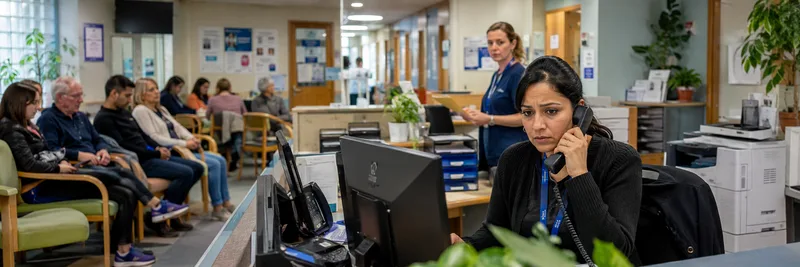
GP practice receptionist on phone at front desk

Some patients need a lower threshold for escalation when deterioration is reported. Babies, children, frail adults, care-home residents, people with learning disabilities and people who cannot clearly describe symptoms may become unsafe before the problem is fully understood.

Vulnerability does not mean reception staff should make clinical decisions. It means uncertainty should be escalated sooner, especially when the caller describes a change in behaviour, alertness, drinking, urine, breathing or ability to manage.

Use extra caution when the contact involves

  • Babies or children who are sleepier than usual, not drinking, breathing differently, not passing urine or described as "not themselves".
  • Frail older adults with sudden weakness, falls, confusion, reduced drinking or reduced urine.
  • Care-home residents where staff report a clear change from baseline.
  • People with learning disabilities or communication difficulties where behaviour change may be the main sign of illness.
  • Recently discharged patients who say they are worsening, unable to manage or unclear about follow-up.
  • Patients living alone where failed contact, confusion or reduced mobility may increase risk.

Listen to people who know the patient

A relative, carer or care worker may know the patient's normal behaviour and ability. "This is not normal for them" can be important safety information, even when the symptom list is incomplete.

When the patient is vulnerable and the information is uncertain, escalate rather than attempting to make a clinical judgement at reception.

Scenario

A parent says their child is much sleepier than earlier and not drinking.

Why is a lower threshold for escalation safer?

14 Recognising deterioration in people with a learning disabilities

Video: 2m 56s · Creator: NHS England Workforce, Training and Education. YouTube Standard Licence.

This NHS England Workforce, Training and Education video explains why recognising deterioration can be harder when someone has a learning disability or autism and may not be able to say exactly how they feel. It focuses on sepsis and infection, noting that early signs can be vague and that people with learning disabilities have a shorter life expectancy and are more likely than the average person to die from infections such as pneumonia or sepsis.

The video gives examples of increased infection risk: swallowing difficulties that can lead to chest infections, constipation that can contribute to urinary tract infections, and difficulty getting a drink or going to the toilet when needed.

It advises carers and staff to notice soft signs of deterioration, because a subtle behaviour change may be the first or only sign that someone is becoming unwell. Prevention advice includes supporting safe eating where swallowing is difficult, helping with toileting, supporting dental care, encouraging hydration and immunisations, and asking a manager or senior colleague for advice when concerned.

Was this video a good fit for this page?

When a vulnerable patient is described as worse, not themselves or unable to manage, uncertainty should lower the threshold for escalation.


Ask Dr. Aiden


Rate this page


Course tools & details Study tools, course details, quality and recommendations
Funding & COI Media Credits
