

Welcome
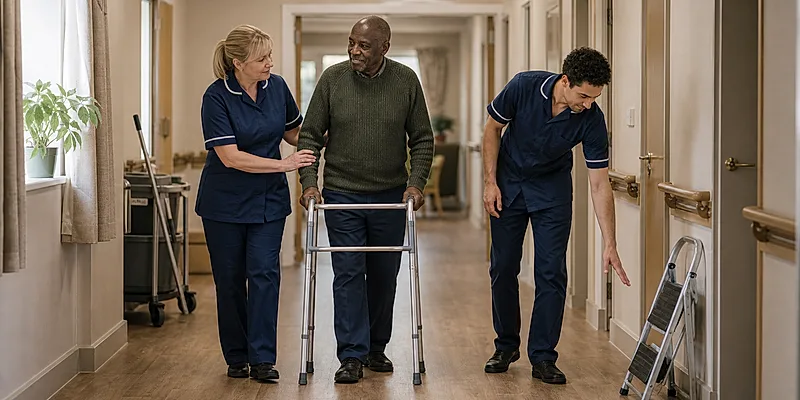
Slips, trips, falls, ladders and steps are everyday safety issues in residential and nursing homes, supported living and other adult social care settings. They commonly involve wet floors, cluttered corridors, laundry, trailing cables, poor lighting, outdoor routes, stairs, step stools, stepladders, storage tasks and rushed work during busy shifts.
This course is for care assistants, senior carers, support workers, activity staff, housekeeping and domestic staff, maintenance teams, team leaders, supervisors and other frontline care staff. It focuses on practical prevention: spotting hazards, dealing with what you can safely fix, reporting what you cannot, and using ladders and steps only when it is safe and appropriate.
This course is written for care staff across the UK. It uses Great Britain HSE guidance on slips and trips, health and social care settings, work at height, ladders and stepladders, with Northern Ireland signposting through HSENI where reporting or enforcement arrangements differ. CQC Fundamental Standards are referenced as England-specific examples; providers in Wales, Scotland and Northern Ireland should follow their own regulator, employer policy and local procedures.
Why This Course Matters
- These incidents are common: HSE identifies slips, trips and falls as a major source of injury in health and social care work.
- Care homes have mixed risks: staff, residents, visitors, contractors and families often share routes while having different mobility, vision, cognition and support needs.
- Small hazards can cause serious harm: a damp floor, trailing cable, loose mat or blocked route can lead to fractures, head injury, loss of confidence, staff absence or avoidable distress.
- Ladders and steps need separate thinking: working at height, even at low level, must not mean standing on chairs, beds, boxes, wheelchairs, trolleys or tables.
- Reporting prevents repeats: recording hazards, near misses and incidents helps managers spot patterns before someone is injured.
How This Course Will Help You
By the end of the course you should be better able to recognise common slip, trip, floor, stair and access hazards, adopt safer everyday practices, judge when ladders or stepladders are appropriate, support residents and visitors safely, and report hazards in a way that helps the service improve.
A Simple Safety Spine
- See it: notice wet floors, clutter, poor lighting, uneven surfaces, blocked routes and unsafe access.
- Sort it if safe: remove simple hazards, clean or isolate spillages, move obstructions and use the right equipment.
- Stop if unsafe: do not improvise with chairs, boxes or unstable steps, and do not start tasks that need help.
- Report it: tell the right person, record what happened and escalate urgent or repeated hazards.
- Learn from it: treat near misses as warnings that can prevent future harm.
Rate this page
Sign up now for a free account
Course tools & details

