

Welcome
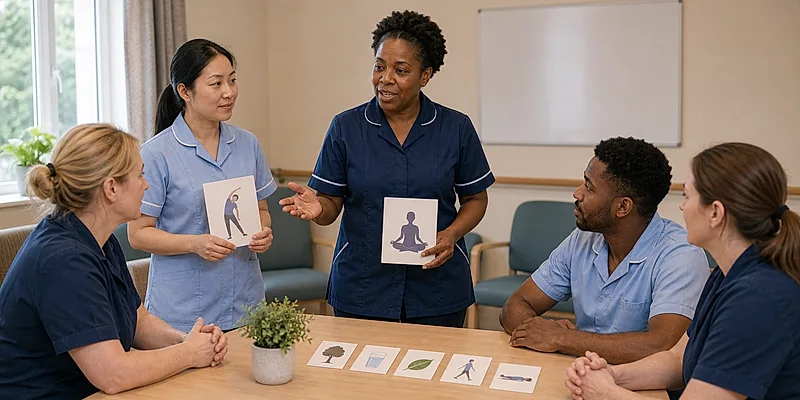
Care home staff routinely face multiple sources of stress: hands-on care, distressed residents, difficult conversations with relatives, paperwork, medicines administration, safeguarding concerns, staff shortages, missed breaks and physically demanding tasks. This short course outlines nine practical approaches that can help staff respond more effectively to those pressures and helps you choose which full course or courses to study next.
Stress | NHS
This course is for care assistants, senior carers, support workers, nurses, team leaders, activity staff, managers and other staff in care homes, nursing homes and adult social care. It draws mainly on UK workplace stress guidance and care-sector wellbeing resources. Because support routes and regulatory details vary across England, Scotland, Wales and Northern Ireland, follow local employer policy and relevant national or regional pathways.
This overview is not training in psychotherapy. It compares nine stress-management approaches, highlights what each does well, and shows the situations, people and stress patterns each method may suit.
Why this overview matters
- Different techniques help in different ways: some address unhelpful thoughts, others reduce body tension, some build longer-term resilience, and some help with repeated unavoidable pressures.
- Stress in care homes is often multi-component: a difficult shift can combine thoughts, emotions, physical strain, behaviour and environmental pressures.
- Choosing the right tool improves outcomes: matching a technique to the problem usually works better than applying a method indiscriminately.
- Many staff benefit from more than one approach: for example, a quick physical reset for immediate tension plus a cognitive or reflective method for recurring patterns.
How to use this course
- Read each page comparatively: note what the technique addresses, what it does not, and whether the scenarios match your typical pressures.
- Consider timing: some methods work in the moment, others between tasks, and some over days or weeks.
- Consider fit: some people prefer structured thought-based tools, others prefer body-based or values-based methods.
- Use the course as a decision aid: by the end you should have a clearer idea which standalone course to study next.
Full Courses Covered in This Overview
- CBT Techniques for Stress Management in Care Homes
- The CBT Five-Part Model for Stress Management in Care Homes
- Mindfulness for Care Staff
- Acceptance-Based Stress Management for Care Staff
- Acceptance and Commitment Therapy for Care Staff
- Self-Compassion for Care Staff
- Resilience Training for Care Staff
- Progressive Relaxation Techniques for Care Staff
- Physical Exercise for Stress Management in Care Homes
Rate this page
Sign up now for a free account
Course tools & details

