

Welcome
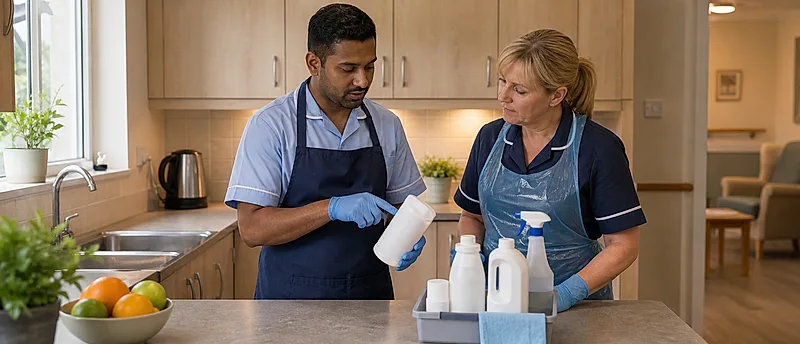
COSHH means the Control of Substances Hazardous to Health. In care homes it covers protecting staff, residents, visitors, cleaners, maintenance workers and contractors from substances that can harm health if they are used, stored, mixed, spilled or disposed of incorrectly.
This course is aimed at care assistants, senior carers, support workers, team leaders, activity staff, housekeeping and laundry staff, cleaners and other frontline care-home workers who may work with or near hazardous substances. It is a UK-wide practical course: HSE guidance applies across Great Britain, while Northern Ireland follows an equivalent COSHH NI framework through HSENI. Adult social care IPC guidance is referenced where it clarifies biological exposure, laundry, waste and body-fluid risks.
Why This Course Matters
- Hazards are often routine: cleaning products, disinfectants, laundry chemicals, body fluids, contaminated waste and some medicines can all cause COSHH risks.
- Care homes are people's homes: controls must protect staff and residents without making the environment feel clinical or restrictive.
- Exposure occurs in different ways: skin contact, splashes to the eyes, inhaling vapour or mist, swallowing, injection injury or contact with contaminated surfaces.
- PPE is not the whole answer: using safer products, correct storage, clear procedures, training and supervision usually reduce risk more effectively.
- Small shortcuts can cause serious harm: unlabelled bottles, mixed chemicals, poor ventilation and improvised spill clean-up can become unsafe quickly.
How This Course Will Help You
By the end of the course you should be better able to recognise COSHH hazards in care-home work, read labels and local safety information, follow risk controls, use PPE and skin protection correctly, and respond to spillages, exposure incidents, waste and related concerns.
A Simple 6-Step Learner Spine
- Identify the substance: do not guess what a product or spill is.
- Check the local procedure: know where COSHH and safety information is kept.
- Prevent exposure: use safer products, methods, storage and access controls.
- Use PPE correctly: wear the right protection for the task, not just any gloves.
- Act safely in incidents: protect people, escalate and follow the spill or exposure procedure.
- Report and learn: near misses, skin problems and unsafe storage all need follow-up.
Rate this page
Sign up now for a free account
Course tools & details

