

Welcome to GOC Standard 17: Protecting the Reputation of the Optical Profession
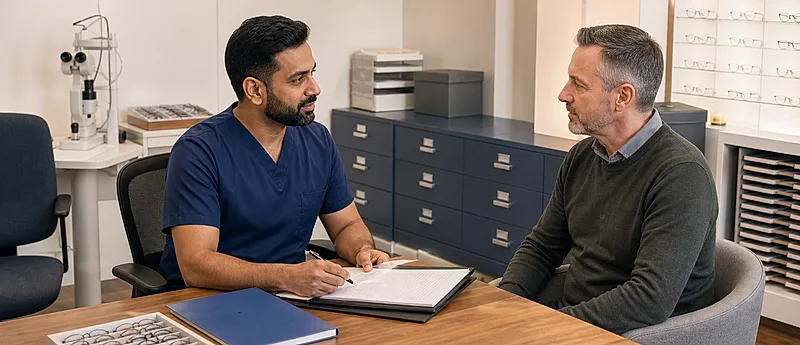
Welcome to this focused course on GOC Standard 17: Promoting Public Confidence Through Professional Behaviour. This course is designed for anyone working in optical care - clinicians, dispensing staff, reception teams, managers and locums - who wants practical guidance to prevent reputational harm and to respond swiftly and professionally when issues arise.
A strong professional reputation underpins safe care: trust supports disclosure, follow‑up and adherence, while visible lapses can damage public confidence in the whole profession. This course translates Standard 17 into everyday actions, controls and simple recording practices you can apply immediately.
Public confidence is a safety control. Small, repeatable behaviours - tone, clear explanations and timely apologies - matter as much as policy. This course helps you embed those behaviours and the systems that support them.
What you will learn
- Understand GOC Standard 17 and the "Reasonable Observer" test for reputational risk.
- Identify everyday behaviours and environmental factors that protect or harm public confidence.
- Apply practical scripts and front‑of‑house actions for common high‑visibility incidents.
- Use a concise incident record template to capture facts, actions and learning.
- Manage digital and social media risks with clear pre‑publication checks and removal procedures.
- Improve leadership, induction and rehearsal techniques to embed expected public behaviour.
- Measure key indicators that flag reputation risk and trigger system fixes.
The Reasonable Observer Test (short)
Would an ordinary member of the public, seeing or reading about the behaviour and knowing the person works in eye care, think less of the profession? If yes → reputational risk exists and should be managed.
How this course will help you in practice
By the end of this course you will be able to:
- Prevent common public‑facing problems by changing small behaviours and putting simple controls in place (side rooms, scripts, signage).
- Lead calm, proportionate responses to incidents: immediate control, factual documentation, and system fixes.
- Record incidents in a factual, proportionate way that supports learning and proportionate governance.
- Reduce escalation by using short apology and relocation scripts, and by rehearsing responses with your team.
- Apply straightforward digital and marketing checks so online content and staff posts do not undermine trust.
High‑yield actions you can use today
- Move disagreements away from waiting areas; appoint a front‑of‑house lead to reassure others.
- Use plain language for delays, fees and clinical findings; offer a brief apology and a concrete fix with a timeframe.
- Record date, time, roles, quotes (where relevant), immediate impact and follow‑up actions with named owners.
- Pause before posting online; preserve screenshots of any public incident and avoid public comment while you assess.
Quick apology examples:
- "I'm very sorry for the disruption. We're addressing this now and will update you within X minutes."
- "I'm sorry for the confusion about the fee. The charge for X is £Y. Here are your options and the timeframes."
Incident response framework (three steps)
- Immediate control: ensure safety, relocate involved parties to a private area, appoint a visible communicator to waiting patients.
- Documentation & accountability: record factual incident details immediately using a simple template (who, what, when, impact, immediate actions).
- System fix & learning: assign owners for follow‑up, review root causes, update scripts/signage/training and log decisions for governance.
Digital, social media and marketing basics
- Assume any content can become public - pause before posting and separate personal/professional profiles where possible.
- Do not post discriminatory remarks, case details or jokes about patients. Screenshots circulate fast.
- For practice channels: use pre‑publication checks, moderation rules and sign‑off against lay‑reader understanding.
- If removal is needed: screenshot for records, note who posted and when, assess spread, and decide whether an external statement is needed.
Leadership, culture and training
Leaders protect reputation by modelling calm corrections in public, keeping critiques private, and publicly thanking staff for de‑escalation. Provide short induction one‑pagers for locums, run role‑plays for hot moments, and rehearse brief, scripted responses so staff can act without improvisation.
Measurement and continuous improvement
Watch for:
- Complaint themes (tone, rudeness, public arguments) and frequency of high‑visibility events.
- Social media incidents involving staff or brand.
- Parity of explanations and outcomes across different patient groups.
- Time from incident to visible fix.
Use these signals to trigger system fixes (staffing at peaks, signage, rota process changes) rather than repeated reminders.
Who this course is for
- Clinical teams, dispensing staff and receptionists who interact with patients daily.
- Practice managers and leaders responsible for policy, training and governance.
- Locums and temporary staff who need concise orientation to public behaviour expectations.
- Anyone responsible for practice marketing, social media or public representation.
How to use this course
- Work through the short modules and keep the incident and checklist templates to hand.
- Run one quick role‑play in your team after finishing: move a disagreement to a side room, practise a short apology and record the incident.
- Choose one control to test for two weeks (e.g., a side room + opening huddle) and review its effect using simple metrics.
Final practical reminders
- Reputation protection is everyday and pragmatic: tone, scripts, environment and quick fixes count.
- Record facts promptly and proportionately, with named owners and review dates.
- Lead by example, rehearse responses, measure trends and prefer system fixes to repeated reminders.
We're glad you're taking this step to strengthen public confidence in optical care. The actions you learn here will help protect patients, staff and the profession.
Sign up now for a free account
Course tools & details

